
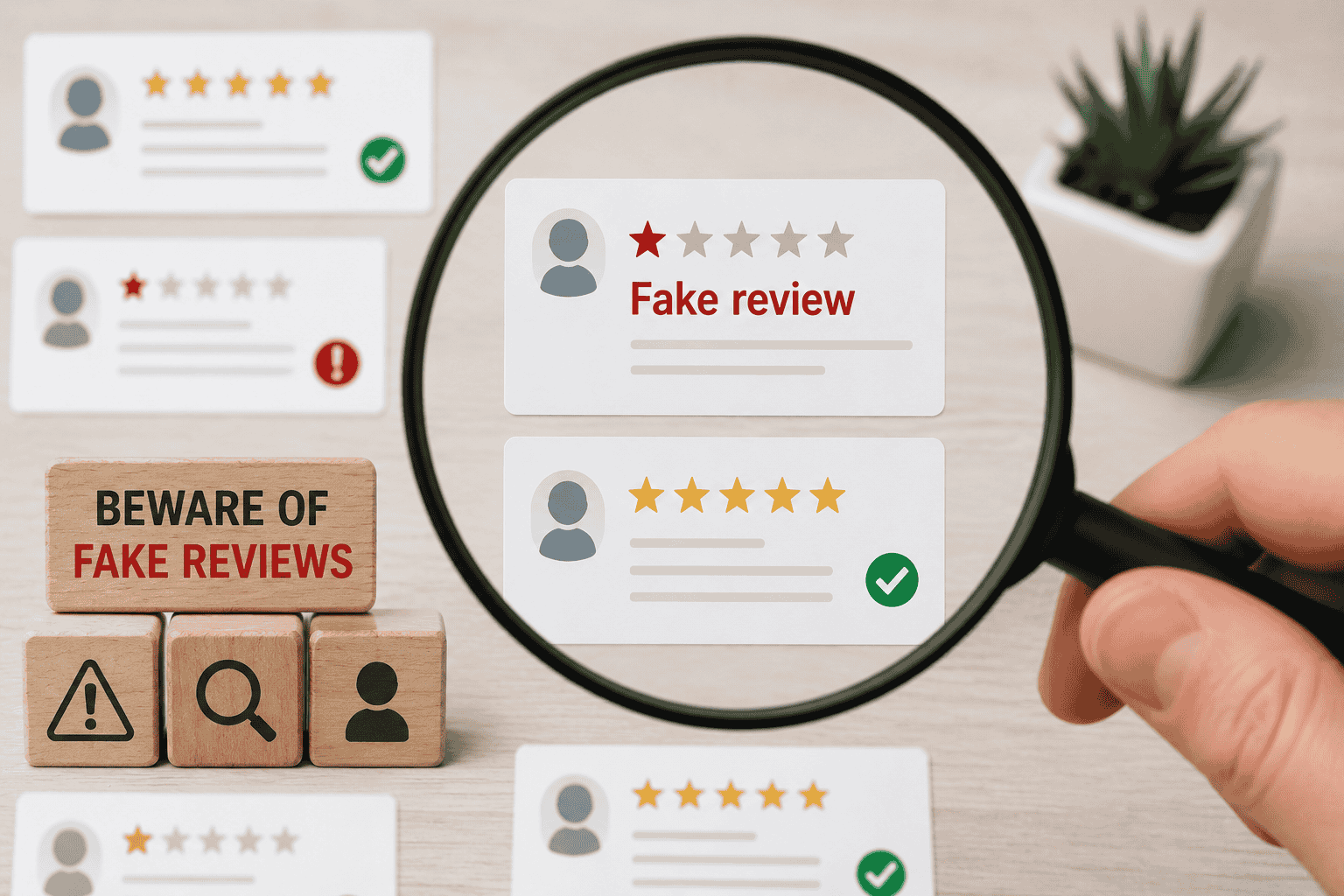
Online reviews are meant to help people make better decisions. They allow customers to share real experiences, compare businesses, avoid poor service, and discover companies they can trust. But as reviews have become more influential, some people have also tried to misuse them.
Fake reviews can appear in different forms. Some may be overly positive reviews written to make a business look better than it really is. Others may be unfair negative reviews created to damage a competitor’s reputation. In both cases, review fraud makes it harder for customers to make informed choices.
The good news is that fake reviews often leave clues. You do not need to be an expert to notice when something feels suspicious. By learning a few practical warning signs, you can read reviews more carefully and protect yourself from misleading information.
Here is how to spot fake reviews before they influence your decision.
Why Fake Reviews Are a Problem
Fake reviews are not just annoying. They can seriously affect how people choose businesses, products, and services.
A dishonest five-star review can convince someone to buy from a company that does not deliver what it promises. A fake one-star review can unfairly damage a business that is actually reliable. Both situations reduce trust and create confusion for everyone.
Reviews work best when they are honest, specific, and based on real experiences. When fake feedback enters the conversation, it becomes harder for users to separate genuine customer opinions from manipulation.
That is why learning to identify suspicious reviews is an important part of being a smarter online buyer.
Watch Out for Reviews That Are Too Generic
One of the most common signs of a fake review is vague language.
Real customers usually mention specific details about their experience. They may describe the product they bought, the service they used, the delivery time, the communication, the pricing, or how the company handled a problem.
Fake reviews often sound generic because the writer may not have had a real experience with the business. Phrases like “Amazing service,” “Best company ever,” or “Highly recommended” can be genuine, but if there is no detail behind them, they are less useful.
A trustworthy review usually answers basic questions: what happened, what was purchased, what went well, what went wrong, and whether the customer would use the business again.
The more specific the review, the more valuable it becomes.
Look for Repeated Phrases
Another warning sign is repetition.
If several reviews use the same phrases, structure, or unusual wording, they may not be completely authentic. This can happen when reviews are copied, generated from a template, or written by the same person using multiple accounts.
For example, if many reviews say almost exactly the same thing, such as “professional team, excellent quality, fast service, highly recommended,” without adding unique details, it is worth being cautious.
Real customers usually describe experiences in different ways. They have different priorities, expectations, writing styles, and levels of detail. A natural review profile should contain variety.
Repetition does not automatically prove fraud, but it is a signal that you should look more carefully.
Be Careful With Sudden Review Spikes
Timing can reveal a lot.
If a business receives many reviews in a very short period, especially after having little or no activity before, that can be suspicious. A sudden wave of five-star reviews may indicate a review campaign, an incentive program, or artificial activity.
The same applies to sudden waves of negative reviews. If many one-star reviews appear within a few hours or days, especially with similar language, it could be coordinated or unfair.
This does not mean every spike is fake. A business may receive more reviews after a popular promotion, a viral post, a product launch, or a busy season. But unusual timing should make you pause and evaluate the reviews more carefully.
Look for whether the reviews sound natural, whether they include details, and whether they come from different types of customers.
Check the Balance of Positive and Negative Feedback
A perfect review profile may look attractive, but it is not always the most realistic.
Every business can make mistakes. Deliveries can be delayed. Communication can fail. Products can arrive damaged. A company with hundreds of reviews and no criticism at all may deserve a closer look.
Authentic review profiles often include a mix of experiences. The key is not whether a business has negative reviews, but how common they are, what customers complain about, and how the company responds.
A business with mostly positive reviews and a few fair, detailed negative reviews can look more trustworthy than a business where every review sounds overly perfect.
Real feedback usually has texture. It includes praise, criticism, nuance, and context.
Pay Attention to Extremely Emotional Reviews
Very emotional reviews can be real, but they should be read carefully.
A review that uses extreme language without explaining the situation may not give you enough reliable information. Statements like “This company is a scam” or “The best business in the world” are less useful if they do not include facts.
When reading emotional reviews, focus on the evidence. Does the reviewer explain what happened? Do they describe the product or service? Did they contact the company? Was there a clear issue? Did the business respond?
Emotion is normal, especially after a very good or very bad experience. But emotion without context should not be your only basis for making a decision.
Review the Reviewer Profile
Sometimes the reviewer’s activity can also provide clues.
A profile that has written many reviews across different businesses, with a mix of positive and negative experiences, may seem more natural. A profile that only has one review is not automatically fake, but it gives you less context.
Be cautious if a reviewer has posted many similar reviews in a short period, reviews businesses in unrelated locations, or uses the same wording repeatedly. These patterns can suggest that the reviews may not reflect real customer experiences.
Again, this is not proof by itself. New customers create accounts every day. But profile behavior can help you decide how much weight to give a review.
Look for Undisclosed Incentives
Some reviews are influenced by rewards, discounts, free products, or special treatment. Incentivized reviews are not always dishonest, but they should be clearly disclosed.
A review written after receiving a discount or free product may still be useful, but readers deserve to know the context. Without disclosure, the review may appear more independent than it actually is.
When reading reviews, be alert to language that sounds promotional or overly polished. If the review feels more like advertising than a real customer experience, it may not be fully reliable.
A trustworthy review should feel honest, personal, and balanced.
Do Not Rely on One Review Alone
The safest way to avoid being misled is to avoid making decisions based on a single review.
One review can be helpful, but patterns are more reliable. Read several reviews across different ratings. Compare recent feedback with older feedback. Look at what customers repeatedly praise or criticize.
If many independent reviews mention the same strength, that strength is probably real. If many customers complain about the same issue, that issue is worth taking seriously.
Good decisions come from comparing signals, not reacting to one opinion.
What to Do If a Review Seems Suspicious
If a review looks suspicious, do not immediately assume the entire business is dishonest. Instead, use it as a reason to investigate further.
Read more reviews. Check recent activity. Look for detailed feedback. See whether the company responds professionally. Visit the company’s website and review its policies, pricing, contact information, and customer support options.
If the platform allows users to report suspicious content, use that feature responsibly. Reporting questionable reviews helps protect the community and improves the quality of information available to everyone.
The goal is not to attack businesses or reviewers. The goal is to keep the review environment fair, useful, and trustworthy.
Final Thoughts
Fake reviews can mislead customers, damage honest businesses, and weaken trust in online feedback. But most suspicious reviews are not impossible to detect.
Look for vague language, repeated phrases, unusual timing, extreme claims, unnatural rating patterns, and missing details. Compare multiple reviews instead of relying on one opinion. Pay attention to how businesses respond and whether the feedback feels specific, balanced, and real.
Online reviews are still one of the most valuable tools for making better decisions. The key is learning how to read them with care.
When you know what to look for, you can avoid misleading signals, choose businesses with more confidence, and help support a more honest review community.
0 Comments
Login or create an account to leave comments